- Jan 29, 2025
Have you been putting off having a hearing test?
- Tom Donaldson
- Hearing and tinnitus
- 0 comments
Have you gradually been finding it more difficult to hear in noisy environments?
Do you find it difficult to understand conversations on the phone, perhaps with the higher pitched and softer voices of your daughter, or granddaughter?
Have you been avoiding going for a hearing test?
When is it urgent and potentially critical?
You should seek urgent medical care (from your doctor) or Accident & Emergency at hospital if your doctor is not available that day. Also book an audiologist appointment:
If you have sudden hearing loss
If you have rapid deterioration in one ear
If you have a serious ear infection, a head injury, or potentially an acoustic neuroma it is time critical to get treatment to minimise the impact and risks. Your doctor may refer you to an ENT specialist.
A hearing test is simple, not painful and can be free - so why avoid it?
A pure tone hearing test is the most common type of test used to find the volume at which you can hear sounds in each ear at different frequencies. It will typically only take around 15 to 30 minutes and is an interesting, rather than painful experience.
You can do an online test at home and it is not a bad thing to do as a first step, but I do recommend getting a proper assessment from an audiologist. When booking a test let them know if you have tinnitus as it could impact how they conduct the test. They may also want to carry out further testing (beyond the simple pure-tone test). I will describe some of the other tests later in this blog.
Ideally avoid exposure to any loud noise for 24 hours before your hearing test.
The majority of people with tinnitus (and some say it can be as high as 90%) also have some degree of hearing loss. In most cases the sound frequency of your tinnitus matches the sound frequency of the hearing loss. This says something about why we experience tinnitus - I will cover that in more detail in a separate blog!
The above means if you have high frequency tinnitus, you will most likely also notice difficulty hearing high frequency sounds.
What you should consider before arranging the hearing test
If you have tinnitus, I recommend trying to find an audiologist who has experience of helping people with tinnitus. Check the website of the clinic, look for cases studies and the profiles of each practitioner. A recommendation from a trusted friend is worth having.
For members of Tinnitus Tunes we share recommendations of clinical specialists in different countries including audiologists with tinnitus treatment experience. You can join Tinnitus Tunes by subscribing to the online course "Tune out your tinnitus".
Many of the hearing clinics are associated with one brand of hearing aid. My preference is to select a clinic that is independent and therefore has more flexibility to recommend the best hearing aid for you.
Most audiologists are professional and operate with integrity. However, be aware they make money from selling you a hearing aid. My recommendation is do not be rushed into trying, or buying a hearing aid. Simply say you want to talk to your family and have some time to take in the results of the test (I cover how to interpret the test results in the next section of this blog).
If you have mild hearing loss, there are alternative technology solutions that are cheaper than traditional hearing aids (another reason not to be rushed into buying traditional hearing aids). I will cover alternative options in my next blog.
How to interpret an audiogram from a pure-tone hearing test
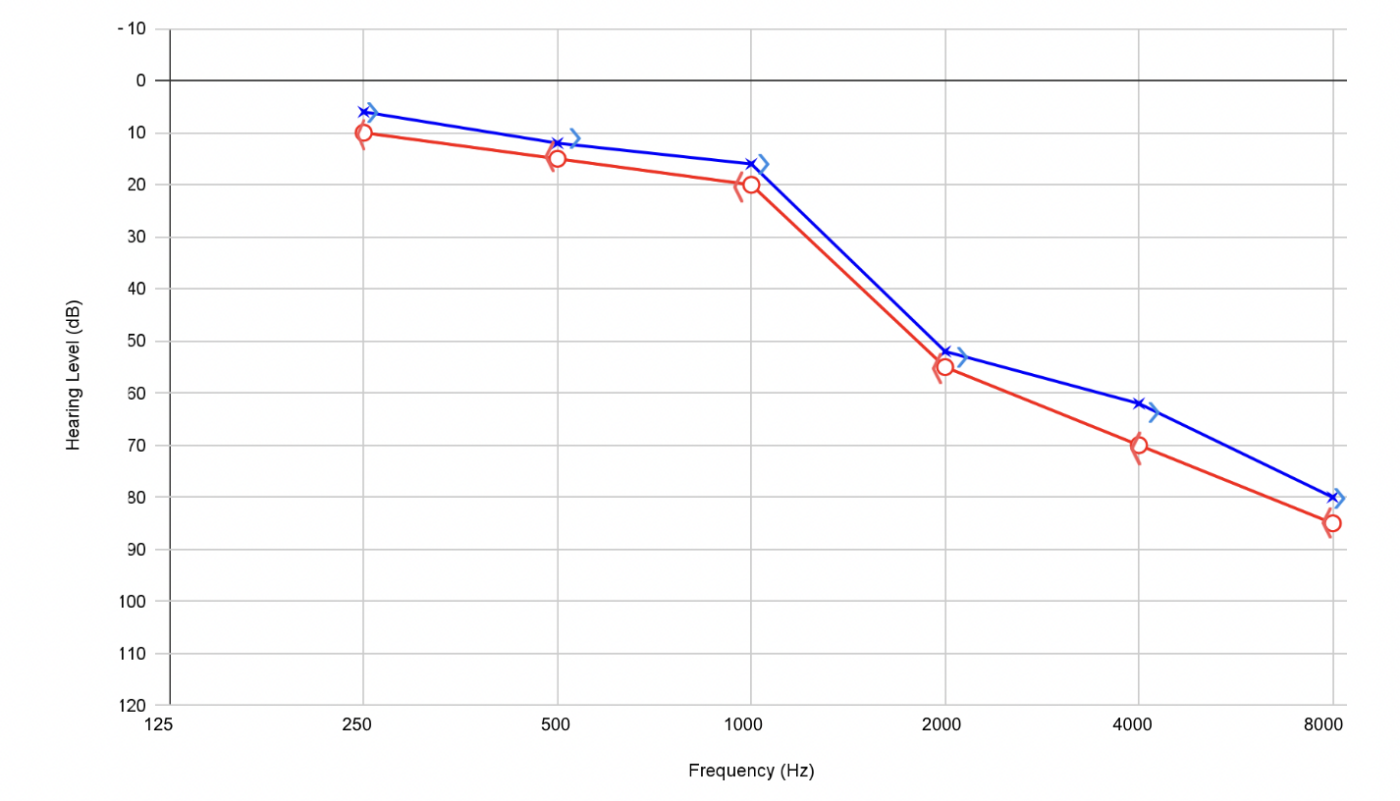
The hearing test will check the lowest volume (hearing threshold) you can hear sounds across a range of frequencies. Typically starting with the low frequencies (250 Hz) and working up to the high frequencies (8000 Hz ). The results are then plotted on a graph for each frequency band and for each ear. The red audiogram symbols usually represent the right ear and blue symbols the left ear.
The X-Axis is the frequency and the Y-Axis in decibels (dB) is the hearing threshold at each frequency step. The ranges used to describe your hearing loss at each frequency band are:
Normal hearing range is from 0 to 24dB
Mild hearing loss is from 25 to 39dB
Moderate hearing loss is from 40 to 54dB
Moderate to severe hearing loss is from 55 to 69dB
Severe hearing loss is from 70 to 89dB
Profound hearing loss is 90dB and above
The slope of the plotted results is also important and will be interpreted by the audiologist. The example image given above is one of the most common results, sometimes described as the "ski-slope". It demonstrates loss of hearing at the higher frequencies. In this example there is not much difference between hearing in the right and left ear.
Another example can be a significant hearing loss at just one frequency range (as mentioned earlier, in line with the frequency of your tinnitus.)
In a "flat loss" audiogram the results are almost horizontal on the graph, with perhaps a 5 or 10 dB variation across the frequency ranges. This kind of loss can be an indication of conductive loss (your audiologist can explain.) It can of course be indicative of excellent hearing across all frequencies!
More unusual is a "reverse slope" where your hearing loss is at the lower frequency range.
Other types of tests
We have spent some time on the simple "pure-tone" hearing test as it is the test you are most likely to be offered by a hearing clinic, particularly if it is a free test.
An interesting statistic is about 20% of people who report having difficulty hearing before the test are found to have normal hearing. This can be a good reason for completing the "hearing handicap inventory" before you go for your hearing test. As the name suggests it provides an opportunity for you to assess how much impact your hearing is having on your day-to-day living.
Bone Conduction Test
This test is used to assess if there are any issues with the tiny hair-cells in your cochlea (part of your inner ear). The cochlea sends vibrations to your auditory nerve and then onto the part of your brain responsible for managing your hearing.
Speech testing
This test involves listening to and repeating certain words. It asseses your ability to understand and process speech.
Auditory brainstem response (ABR) test
This tests the neural pathways between your ear and the processing centre in the brain (so complements the bone conduction test). It can also be used where a pure-tone test cannot be used, for example with young children. It is also used where there has been a brain injury.
Tympanometry test
This is used to check how well your eardrum is moving. This is used to look for a ruptured eardrum, fluid in the middle ear, or a severe build up of wax in your ear canal.
There are other types of tests available for specific situations, but the above hopefully gives you a good overview of the hearing test landscape.
We would like to thank you for reading our blogs. We acknowledge that the content of this blog will only be relevant for part of our audience.
Please let us know if there is a topic you would like to know more about and we can use your feedback to create a new blog. We also welcome feedback on this blog, either by leaving a comment or sending me an email at thomasdonaldson707@gmail.com
On behalf of my friendly support team, kind regards from Tom Donaldson.